

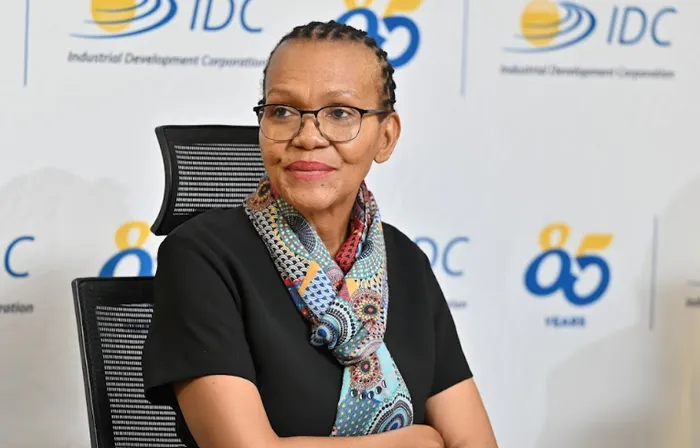
IDC CEO Mmakgoshi Lekhethe emphasised that transformation remains central to the institution’s mandate, despite recent public scrutiny over governance concerns and claims of bias.
Image: Supplied
The Industrial Development Corporation (IDC) has pushed back against allegations of anti-transformation practices, reaffirming its commitment to supporting black-owned businesses while acknowledging the mounting pressures facing companies in a weak economic environment.
This comes after the National African Federated Chamber of Commerce and Industry (Nafcoc) petitioned Parliament in October 2025, accusing the IDC of undermining black industrialists through aggressive recovery actions, premature legal enforcement and liquidation processes.
Earlier this year, Parliament said it would establish a formal inquiry into the affairs of the IDC following allegations that it discriminated against black-owned enterprises and deviated from its transformation mandate.
Speaking at a media briefing last week, IDC CEO Mmakgoshi Lekhethe emphasised that transformation remains central to the institution’s mandate, despite recent public scrutiny over governance concerns and claims of bias.
“What is often not accurately reflected in public commentary is that around 60% of the IDC’s investment book is consistently invested in black-owned, black-empowered and black-shareholding companies,” Lekhethe said.
“That reality underscores both our transformation focus and the pressures faced by these businesses in a difficult economic climate.”
The briefing came amid heightened debate about the effectiveness of development finance institutions in advancing transformation, particularly as some IDC-funded businesses have faced financial distress or liquidation.
While acknowledging these concerns, Lekhethe cautioned against drawing broad conclusions from isolated cases.
“In the current economic environment, characterised by structural constraints, some businesses are taking strain. Business distress and liquidation are not unique to IDC-funded companies, nor are they unusual in a weak economy,” said Lekhethe.
She pointed to broader economic challenges — including electricity supply disruptions, logistics bottlenecks, rising input costs and subdued growth — as key factors affecting business performance across the country.
According to Statistics South Africa, there were 1,534 company liquidations recorded in 2025, highlighting the difficult operating environment.
Despite these headwinds, Lekhethe said the IDC has continued to expand its support for black industrialists.
Through its partnership with the Department of Trade, Industry and Competition’s Black Industrialists Scheme, the corporation has funded 73 companies to date, with total approvals amounting to approximately R7.28 billion.
At the same time, the institution has stepped up interventions aimed at stabilising struggling businesses. Over the past financial year, the IDC approved around R2bn in funding specifically for distressed companies, deploying measures such as restructuring, balance sheet re-engineering, working capital support and business rescue processes.
Lekhethe stressed that such interventions are part of the IDC’s broader developmental role, which includes not only financing new ventures but also sustaining existing ones through economic downturns.
She also addressed governance-related allegations that have surfaced in recent weeks, reaffirming the organisation’s commitment to ethical conduct and due process.
“The law of this country is clear: individuals are presumed innocent until proven otherwise by a competent legal authority. This principle applies equally to IDC employees,” Lekhethe said.
“While allegations must always be taken seriously and tested through proper processes, unsubstantiated reporting can have serious implications for institutional reputation and stakeholder confidence.”
In a move aimed at strengthening transparency and accountability, IDC chairperson Gloria Serobe announced the planned establishment of an Independent Complaints Review Panel.
The panel will provide an additional layer of oversight in handling client and stakeholder concerns, complementing existing governance structures.
The initiative is intended to bolster confidence in the IDC’s processes without undermining its credit approval systems, ensuring that concerns about fairness and service delivery are addressed more effectively.
The IDC also highlighted its strategic role within government’s broader economic agenda, particularly in driving industrialisation, transformation and inclusive growth.
As South Africa continues to grapple with structural economic challenges, the institution’s ability to balance developmental objectives with financial sustainability remains under close scrutiny.
BUSINESS REPORT