

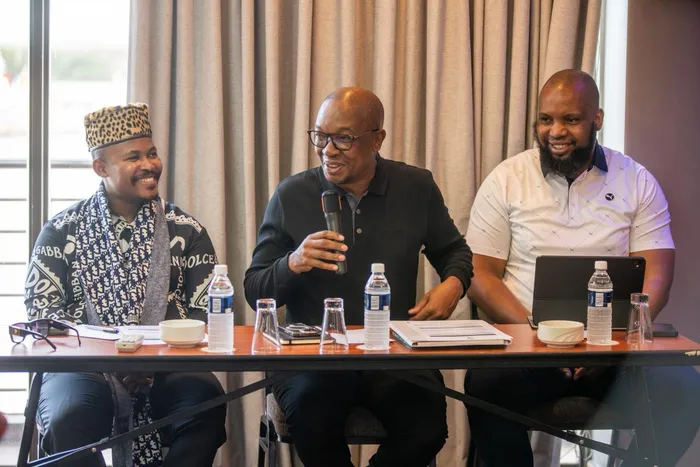
Minister of Trade, Industry and Competition, Parks Tau (centre) with the Royal Chancellor of the Zulu Nation, Inkosi Malusi Zondi (left) and the KwaZulu-Natal MEC for Transport and Human Settlement, Siboniso Duma (right) during a meeting in Richards Bay.
Image: Supplied
Tongaat Hulett continues to trade under “very difficult market conditions,” and an Industrial Development Corporation (IDC) post-commencement funding (PCF) will enable the business to prepare for the upcoming milling season, while the government is preparing a rescue plan.
Tongaat’s business rescue practitioners (BRPs) wrote in an update on Friday that the financial situation of the group remains “dire,” and the Vision Consortium, the IDC, and Business Rescue Practitioners (BRPs) have continued “to attempt to agree on the refinancing of the existing PCF facility of R2.3 billion and the increase of R200 million, should it be utilised.”
A liquidation of what was once South Africa’s biggest sugar producer could put an estimated 40,000 livelihoods in the form of jobs and small cane grower incomes in KwaZulu-Natal at risk.
Also at the weekend, KwaZulu-Natal Transport and Human Settlements MEC Siboniso Duma, in his capacity as Leader of Government Business, welcomed the fact that Minister of Trade, Industry and Competition Parks Tau had remained opposed to the liquidation of Tongaat Hulett.
Duma said Tau was looking towards creating a new structure to save Tongaat Hulett that will see greater involvement by small-scale growers and workers in the group.
Duma said Minister Tau had also said the IDC planned an R8.5bn bid to take over ArcelorMittal, so that its operations remain in Newcastle, and the 3,500 jobs and as much as 100,000 livelihoods may be saved.
“The latest developments as presented by Minister Parks Tau to the Zulu-Royal Chancellor Inkosi Zondi will preserve jobs and put traditional leaders central in driving socio-economic development,” Duma said.
Tongaat Hulett's BRPs have attempted to liquidate the group due to a lack of funds through the business rescue process, in spite of a private sector consortium, the Vision Group, winning a bid to take over the group, and a worsening financial situation.
The initial court hearing in April for a liquidation was postponed to June 17 and 18. The PCF facility end date is June 30, and the BRPs said the facility will need to be repaid in full, or may, at IDC’s discretion, be restructured into a term loan after that date.
The BRPs said in the update that the adjournment of the court proceedings was to provide additional time for the Vision Consortium and IDC to endeavour “to reach an agreement on the funding request and for THL, together with its BRPs and stakeholders, to continue engaging constructively with the objective of reaching a longer-term solution that is in the best interests of the business, its employees, and all stakeholders.”
Tau said in a statement the transformation of the South African economy is critical, and there was no room for apology in pursuing it. Tau made these remarks in a meeting with the Royal Chancellor of the Zulu Nation, Inkosi Malusi Zondi, and the Royal Economic Council in Richards Bay on Friday.
Tau was accompanied by officials of his department, namely the director-general Simphiwe Hamilton, acting deputy director-general of sectors Dr Tebogo Makube, and the acting deputy director-general of incentives, Justice Ngwenya.
The meeting discussed, amongst other matters, government interventions on Tongaat Hulett, ArcelorMittal, developments in the Richards Bay Industrial Development Zone, and the departments' incentive schemes, with a particular focus on the Transformation Fund and the Black Industrialists Program.
The Transformation Fund plans to mobilise R100bn over the five-year term of the current administration through a joint effort between government and the private sector. It will serve as a funding platform wherein inclusive growth is engineered through data, innovation, and partnership. The Black Industrialists Program is designed to accelerate the participation of black-owned businesses in the industrial economy.
Tau said Tongaat Hulett’s operations needed to continue, or its collapse would result in a devastating economic impact.
“It is in everyone’s best interest to intervene and find sustainable solutions. We believe Tongaat can be saved, and we must do everything within our means to ensure its recovery while also safeguarding public funds. Our investments must be deliberate and purposeful,” he said.
Tau said the R200m was intended to sustain operations and prevent immediate collapse, enabling THL to continue operating until at least the end of June 2026.
“The date set by the courts provides an opportunity for all parties to come together and find common ground. On the same note, the government is committed to the efforts of saving ArcelorMittal in Newcastle. The view is that it is possible to find partners, and the offer has been made to buy back the operation.”
Tau said his department was committed to working with the Zulu Nation and other stakeholders to ensure the province fully participates in the economic activities across all sectors.
Nkosi Zondi said there was a need for further engagements on the way forward, should the court rule in favour of the liquidation, as this would destabilise more than 1 million rural livelihoods and trigger immediate non-payment to growers and suppliers.
BUSINESS REPORT